


Earlier this year, an atheist AI company founder warned the Pope about the global pressures influencing frontier laboratories. The encounter was strange, but it made visible a shift that had been unfolding outside public view: AI firms are becoming more than market participants. They are now geopolitical actors, operating at the juncture of state power and global systemic risk.
King Charles’ gathering of senior representatives from Anthropic, Nvidia, Google DeepMind, and OpenAI last week marked another moment in this new world of AI diplomacy, in which tech founders sit alongside spiritual and political leaders.
The Vatican framed the AI conversation around human dignity, the global poor, and the rejection of arms-race logics. The King is now asking whether shared principles can guide its progress—an urgent question as Dario Amodei and Sam Altman warn that development is outpacing safeguards.
Both events demonstrate a distinctively European capacity to convene around questions that neither markets nor governments can resolve alone.
Europe’s convening power has deep roots, from the Congress of Vienna to postwar multilateralism. The UK’s imperial history has left it with unusually dense international channels, while London’s role in global finance, law, and diplomacy distinguishes it in high-level convening. The 2023 AI Safety Summit at Bletchley Park offered a contemporary expression of this ability.
But this convening power also exposes a strategic imbalance. Europe cannot keep providing only the moral vocabulary, principles, and convening spaces while predominantly American and Chinese firms build the technologies, control much of the infrastructure, and accumulate geopolitical influence.
Convening is not capability
The answer is not an indiscriminate European race to build ever-larger models. If frontier capabilities may be developing faster than they can be governed, entering as a tortoise in the same race would hardly constitute strategic agency.
Europe’s task is to turn distributed strengths into collective capability: infrastructure, companies, and applications that can shape how critical technologies are developed and deployed. Horizon Europe already makes cross-border research routine. But Europe has not yet made its capability stack work coherently.
Until 2026, users of participating EuroHPC systems (the EU’s High-Performance Computing infrastructure) faced separate procedures for authentication, allocation, scheduling, and software—fragmentation now being addressed through an early-stage Federation Platform for researchers, SMEs and public authorities.
The problem extends beyond public infrastructure. Europe’s quantum supply chain is distributed across countries, from Dutch lithography and Finnish-Dutch cryogenics to German lasers and Italian-French microcontrollers, while the European Commission identifies fragmented national quantum strategies and incomplete paths from research to industrial scale.
This is a moment of genuine momentum in European tech self-belief, even if unevenly felt across the continent. Campaigns like Balderton’s “Built in Europe” are challenging the narrative that Europe is perpetually behind Silicon Valley.
But confidence alone will not connect Europe’s distributed research, infrastructure, and industrial strengths into scalable capabilities. As Alessandro Scortecci discusses in his account of Generative Bionics’ €70 million seed round, success for even one company requires many components: a viable licensing route, committed capital, strategic technology partners, and credible industrial demand.
Europe must connect its assets internally and with allies: building resilience and growth at home, while becoming a stronger contributor to partner economies and global technology ecosystems. Otherwise, it risks articulating values without the capacity to act on them, leaving its competitiveness, security, and strategic freedom shaped by others.
Integration is strategy
The Triple Transition is one lens for understanding this broader challenge: the need to design advanced technology, low-carbon energy, and defence and security innovation together to support both resilience and growth.
The Baltic states’ synchronisation with continental Europe’s electricity system illustrates the wider principle. In February 2025, Estonia, Latvia and Lithuania disconnected from the Russian-controlled network. Achieving that shift required infrastructure, engineering, cybersecurity, finance, and political coordination across borders—and changed the region’s strategic dependencies and freedom to act. It was not simply an energy project, but capability-building through integration.
The Baltic case shows that resilience and, where needed, the capacity to act independently are built through integration, not just shared priorities. Shared priorities can establish direction, as Ursula von der Leyen and Mark Carney emphasised last week in relation to the EU–Canada relationship. They do not, however, ensure that countries can build together. That requires mechanisms that combine strengths around a defined outcome: shared infrastructure, joint financing, procurement pathways, common standards, and viable routes to market.
Complementarity is not enough
Italy and the UK provide a useful case study. Italy has major computational infrastructure, including the Leonardo supercomputer at CINECA, and deep expertise in HPC and quantum simulation. The UK has parallel strength in AI research, quantum technologies, and software. Almost one-third of Italy’s 5,414 Horizon Europe AI projects include a UK partner.
Yet much UK–Italy cooperation remains project-based and dependent on individual research relationships, with valuable but limited institutional architecture for moving from research collaboration to industrial application.
Italy’s integration of the SOL quantum computer into CINECA’s HPC environment shows what is required: not just co-locating hardware, but combining quantum engineering, classical infrastructure, software and domain expertise—capabilities rarely held by one institution, let alone one country, and slow and costly to develop alone.
Complementarity is only potential. It becomes capability only when potential partners can identify an important problem, assemble the relevant actors, and connect them to the infrastructure, development finance, and routes to adoption required to act. Each country and company must be clear about what it contributes and what it needs from others.
Alliances must connect systems, not only technologies
Some governments are beginning to offer their own public systems as test environments, turning domestic deployment capacity into an instrument of international alliance-building. The Estonian Minister for Justice and Digital Affairs recently explained to me that if companies in the United Kingdom wish to offer services to their government but want to first test them in a real-life situation, they should "come over" to Estonia.
But pilot access is only the first step. Turning such access into deployment requires national systems designed for distinct rules and incentives to work together. They may fund technologies at varying stages, apply incompatible rules to intellectual property, organise infrastructure access differently, or divide responsibilities among research agencies, development banks, defence bodies, and commercial investors in incompatible ways.
This helps explain the growth of a particular form of tech minilateralism: targeted bilateral and small-group arrangements specifically intended to support access to infrastructure, enable joint research, and manage the security considerations associated with sensitive technologies.
Such arrangements should not replace wider European or global institutions. Their value lies in making cooperation more operational: creating a sufficiently trusted setting in which a smaller number of partners can agree what they will build, share, or finance together, and on what terms. They must then develop institutional, financial, and commercial arrangements capable of withstanding political, economic and technological shocks.
The machinery of shared capability
Four practical implications follow for how countries and organisations can build the machinery needed to turn complementary strengths into shared capability.
1. Build around a problem, not a technology
Cooperation is most useful when partners identify a specific problem they can usefully solve together—not just a technology they wish to develop. That might be a quantum–classical workflow that reduces the time to solve a defined scientific problem; an industrial AI service deployable across trusted infrastructure; or an energy technology moved from prototype to a financeable first project.
The alliance can then work backwards: identify a lead user, technical milestones, infrastructure, capital, regulatory approvals, and delivery responsibilities required to reach that outcome. Each partner contributes where it has an advantage, while the partnership exposes what is still missing for a credible route from demonstration to adoption.
The organising question is: what capability must exist by a specified date, who will use it, and which combination of assets is needed to deliver it?
2. Access to infrastructure must include a pathway to use
Europe is investing in a significant distributed infrastructure base. EuroHPC is developing 19 AI Factories and 13 associated Antennas, alongside its existing supercomputing facilities. NATO DIANA similarly gives companies access to accelerators and specialist test centres distributed across allied countries.
But nominal access to supercomputing facilities is different from effective use. A researcher or company may lack a suitable workload, engineering support, secure data access, or the funding to turn an experiment into a deployable product. Providers, meanwhile, may struggle to identify high-value users and convert capacity into sustained demand.
Access must therefore be more than permission to use the machine. It should be embedded in a route to deployment, with integration support, a validation pathway, and ideally even connections to potential users, procurers, and follow-on funding.
In the UK, it is promising to see the government take seriously the need to address these questions through the new Sovereign AI Fund. Alongside equity investment and access to public compute, it has launched a £100 million R&D procurement scheme intended to make government an early customer for novel AI capabilities.
One Sovereign AI fund “challenge” specifically supports hardware and software that can improve the efficiency of public compute and enable heterogeneous systems. Its investment in Callosum, which orchestrates workloads across different chips and models, also reflects a commitment to converting heterogeneous infrastructure into usable capacity.
3. Demand, risk, and capital must enter well before the technology is finished
Cross-border projects often distribute the assets required for deployment across several jurisdictions, while leaving demand, capital, insurance, and regulatory responsibility in separate national systems. These must be aligned well before the technology is finished.
The Sovereign AI Fund offers one national model for the kind of integrated approach cross-border projects will require: combining public compute, equity investment, and procurement. It shows recognition that traditional funding models do not always fit critical technologies. The scale, capital intensity, and long development cycles of some projects can place them between conventional categories: too large or slow for venture capital, but too novel and insufficiently proven for project finance or infrastructure investors.
Low-carbon energy innovation is just one example. The renewable-energy insurance market remains less than 30% of the size of the fossil-fuel insurance market. New technologies frequently lack the historical performance and loss data on which investors and insurers ordinarily rely. Yet banks and project financiers often require insurance before committing capital. The absence of appropriate cover can therefore prevent a project from proceeding even when other capital is available.
Insurability should therefore be treated as a design constraint and a financing instrument, not as cover purchased once development is complete. Bringing insurers and risk engineers into project formation can influence decisions about materials, location, monitoring, performance guarantees and data collection. It can help turn unfamiliar technical risks into risks that can be evidenced, mitigated and transferred—making projects more financeable.
Europe, and London in particular, has considerable underwriting depth. Its value lies in the accumulated judgement required to price novel risks, which should be brought into project design much earlier.
Investors, insurers, users, and procuring institutions should help shape projects alongside researchers and technology companies. These conditions help to build trust that scales: creating the technical evidence, demand, risk allocation, and institutional confidence required for customers and capital to commit.
4. The physical stack must be treated as a strategic capability
Trust also depends on the physical systems through which technology is built and deployed. Regulatory and geopolitical risk can reshape project economics as well as supply chains. The EU’s recent restriction on funding renewable-energy projects using inverters from China, Russia, Iran, and North Korea now applies across major public-finance channels, including the European Investment Bank.
By 2025, the EIB had financed roughly one-fifth of EU solar projects, most using Chinese-made inverters. Some now require unanticipated retrofits, showing how late security requirements can simultaneously affect industrial capacity, insurability, and access to capital.
The EU installed 27.1 GWh of new battery-storage capacity in 2025, up 45% in a year, bringing its total fleet to 77.3 GWh. Around 750 GWh may be needed by 2030 to meet the EU’s flexibility needs.
Yet much of the underlying technology stack remains centred on China. Following Northvolt’s collapse, Europe has no competitive battery-cell manufacturer focused on grid-scale storage.
Restricting particular suppliers and technological components may be justified on security grounds. But it raises a wider question: can Europe and its trusted partners build the physical capacity required to sustain deployment?
Energy is central to that capacity. Data centres could account for 28% of the growth in European electricity demand by 2030, while grid-connection waits in some locations extend to seven or even ten years. EU AI Gigafactory consortia must demonstrate access to substantial contracted low-carbon power and credible grid-capacity pathways. Energy availability will increasingly determine both where advanced-compute capacity is located and where workloads run.
Europe cannot, and need not, reproduce the full physical stack in every country. Countries with particular industrial capabilities can strengthen the collective position. Europe does, however, need a shared view of which capabilities must be secured, which dependencies are tolerable, and where alternatives are needed. It should then connect domestic strengths with trusted partners inside and beyond the EU to share the cost, risk, and benefits of building them.
A Practical Model in Venice
The Ponti Summit in Venice on 1–2 October is an experiment in how to turn complementary strengths into shared capability. Building on our UK–Italy Critical Technologies Roundtable at the Ambassador’s Residence in Rome earlier this year, StateUp, together with the University of Warwick, are bringing together 75 leaders from industry, finance, research, government to originate projects, syndicates, and shared capabilities across the critical-technology stack. We are collaborating with the British Embassy in Rome and UK Government Science and Technology Network.
The visual below maps the capabilities represented within the Ponti community, and the potential connections among people with the expertise, assets, and decision-making authority to tackle shared, large-scale problems.
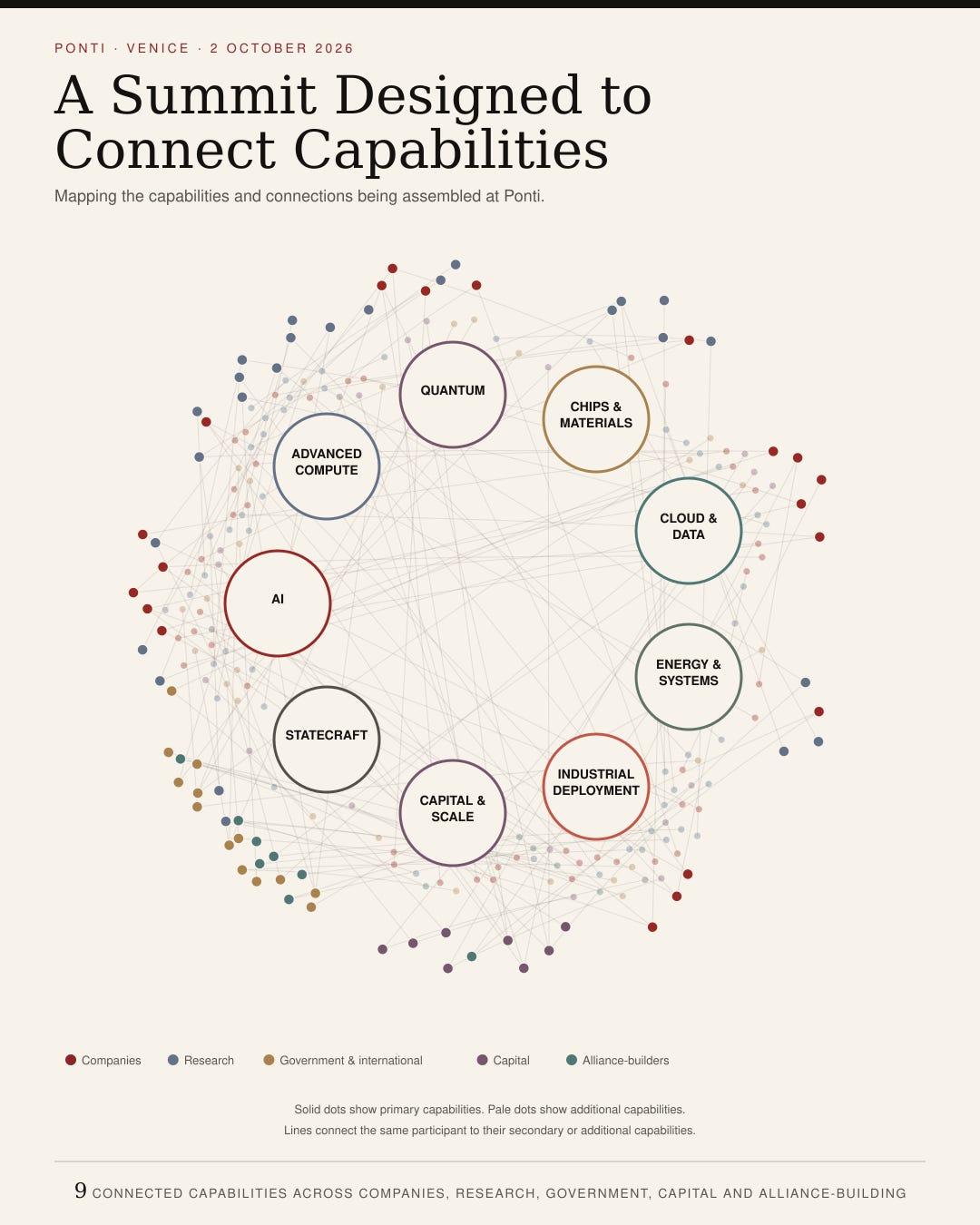
The Ponti capability network. The lines show potential connections among the capabilities represented at the summit, rather than existing institutional partnerships.
The working sessions will focus on practical questions and mechanisms: what Europe should build to turn its industrial strengths into advantage in the frontier-AI economy; how research compute can become usable capability; how quantum and classical systems can converge around defined applications; how energy systems can support advanced compute; and how risk, insurability and capital enable technologies to scale.
The aim is not another declaration of European principles. It is to identify and originate specific projects, access arrangements, co-investments and institutional mechanisms that connect technology, infrastructure, energy, finance, and demand.
Europe’s convening power remains valuable. But it translates into influence only when it produces shared capability. Europe needs technological and industrial agency to realise its principles, not simply articulate them.
If you’re building in advanced compute, energy infrastructure, quantum-classical systems, or the finance and insurance architecture that connects them and want to be part of these conversations, please get in touch.
TechGlo decodes how technology, capital and geopolitics are converging — and what it takes to build the alliances that shape them.
Preview image: kallerna, CC BY-SA 4.0 <https://creativecommons.org/licenses/by-sa/4.0>, via Wikimedia Commons
Where have you seen complementary European technological and industrial strengths convert into shipped capability, and where have you seen it stall?
Well put. Europe convening conversations about human dignity is valuable, but moral authority without capability doesn't carry far at the table. The strongest European voice will come from building and operating its own AI infrastructure alongside the values it champions.